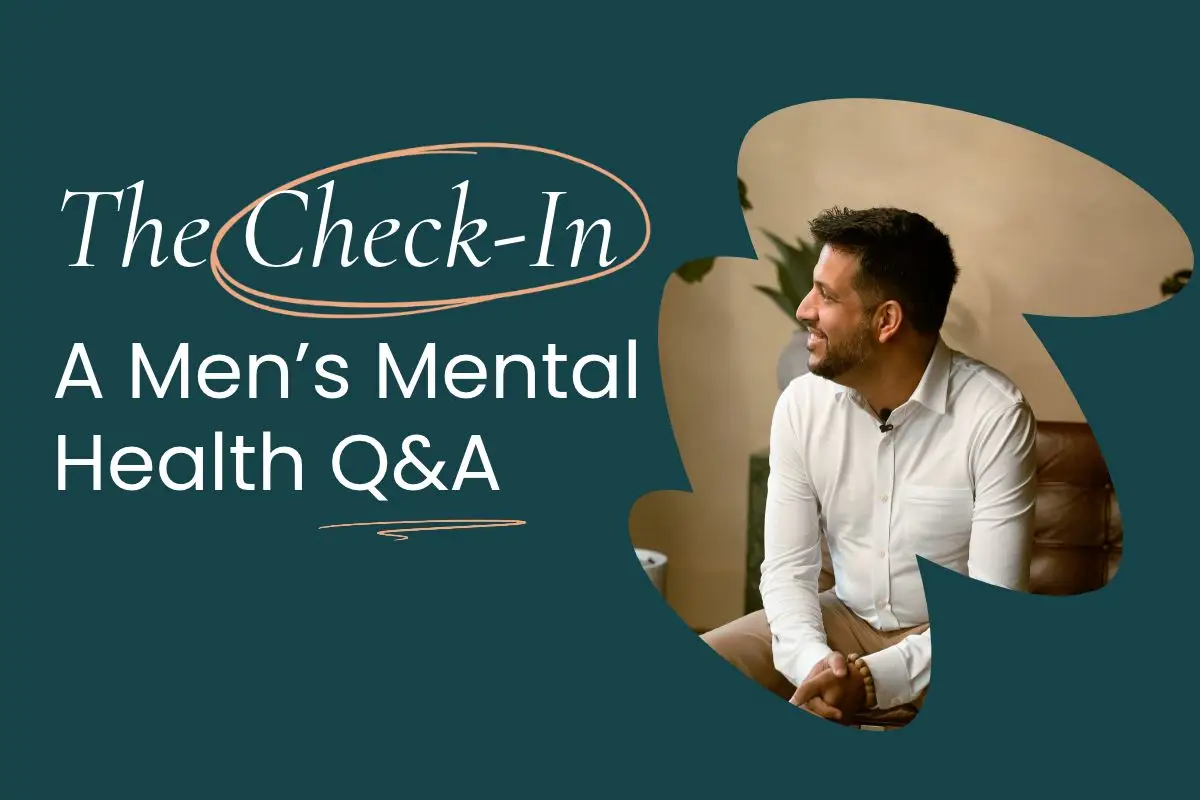
Running on Empty? The Check-In Continues With Our Men's Mental Health Month Q&A

You pull into the driveway after a long day and sit in the car for a minute before heading in. Inside, the kids want to show you what they built, dinner still needs starting, and your phone keeps buzzing with work. People check in on the kids and your partner all the time, and if anyone asked about you, you'd probably say you're fine.

This week in The Check-In, our Men's Mental Health Month Q&A series, we asked Osman Khan, RP (Qualifying), a Shift Collab therapist and dad of four who supports people through feeling stuck, relationship patterns, and finding their sense of identity and purpose, the questions we hear most from dads who are running on empty. If you're in the early years of parenting, our post on mental health tips for dads during the early parenting years is a great next read.

What Does Osman Recommend for Dad Mental Health?

Here's the quick version:

  • Finding it hard to admit you're struggling? Remember that fathers are human too, and the pressure to always have it together comes from the roles we've handed dads for generations.
  • Nothing left by the time you get home? Switch from work mode to me mode first, with a few deep breaths on the car ride home or an extra five minutes in the garage.
  • Catching yourself repeating your dad's silence? Talk about your feelings in front of your kids, since kids act like mirrors.
  • Stopped checking in with yourself? Reconnect with your purpose and values in therapy, so you remember who you are under all the hats you wear.

"Everyone asks how the kids are or how my partner's doing. Nobody really asks about me, and I'm not sure I'd know what to say if they did. Why is it so hard for dads to admit they're struggling?"

Osman: I believe it's so hard for dads to admit that they're struggling because there's this idea that all fathers need to have it together: being the protector, being the provider, being the leader of the home, unable to share vulnerabilities, unable to share when they're struggling.

Part of this is because of the roles that we give fathers and how we possibly as a society view our fathers or grandfathers raising us, and this idea of, it doesn't matter how tough it is, you pull up your socks and you move forward.

But fathers are also human. We're people, and it would be nice if someone asked us how we're doing, and for it to not perhaps be used against us if we are struggling. I think this concept of also being judged is quite apparent in family households.

"By the time I'm home from work, I've got nothing left for my kids, and then I feel guilty about it. What's something I could try at home to switch from work mode to dad mode?"

Osman: I would actually flip this question and say, what can I do to switch from work mode to me mode? So who is dad outside of dad? Who is this male figure? And I think that car ride home, or spending an extra five minutes, 10 minutes in the garage to get your head in the right space.

So again, switching the narrative from work mode to dad mode and making it work mode to me mode, me as a person, and then going from me as a person to dad, would be where I would switch. And so what can we do?

  • Deep breathing
  • Take a moment to reflect on how the day went, what you're hoping to do when you get home, what you're hoping to do for yourself and with your kids
  • And remembering: I do not need to be perfect. I just need to be me.

Thinking about therapy? Meet our therapists who specialize in men's mental health

No items found.

Thinking about therapy? Meet our therapists who specialize in men's mental health

"My dad never really talked about his feelings, and I'm catching myself doing the same thing. What does it look like to show my kids something different?"

Osman: I think showing children that it's okay to talk about emotions and be vulnerable is the best way to model that and help them do the same thing. Kids are not only learned by like sponges, but kids act like mirrors, and so if they see parents able to talk about feelings, they'll be more open to do it themselves.

If we want to create a safe space at home for everyone to talk about feelings and talk about what's going on, the good, the bad, the stressful, the happy, then dads and moms, but particularly dads, need to do the same thing.

"I'm so focused on taking care of everyone else that I've stopped checking in with myself. What would we actually work on together in therapy?"

Osman: In therapy, if you worked with me, we would talk about who are you outside of being a worker, employee, and who are you outside of being a dad. And so the biggest thing working with me is, how do we find your purpose? How do we find who you are? What gets you going? What values you want to live by? And how do we help realign you?

So that now when it comes down to wearing those multiple hats, as a father, as an employee, maybe even as a sibling or a son, you're not forgetting who you are at your core. And so the work involves reconnecting and realigning with who you are as a person. What makes you happy? What gives you a sense of purpose? Not just doing things for people, but what do you do for yourself that helps you align to who you are and what you want to become, and what version of yourself you want to become?

And so working with me helps you realign that. And I may do that through accepting who we are, accepting what purpose we have, and living our values by that acceptance, and showing up the best way we can.

There's nobody perfect out there, and perfection gets in the way of greatness. And greatness comes along when you're really good at something and you work hard and you practice. So now is the time to work hard on yourself, so that you can be a great employee and a great dad.

Ready to Talk to Someone Who Gets It?

Shift Collab matches you with a therapist who understands how the pressure of being a dad shows up in real life, from the drive home after a long day to the conversations you've never quite known how to start. Every session is virtual, so you can get support from anywhere in Canada, and it all starts with a free 15 minute Meet & Greet.

  1. Want to work with Osman? Book a free Meet & Greet with Osman.
  2. Want us to find your match? Take our matching questionnaire.

Disclaimer: This blog is for general information only and isn't a substitute for professional advice, diagnosis, or treatment. Reading it does not establish a therapist-client relationship with Shift Collab or any affiliated therapist. That relationship begins only after intake, consent, and a paid Initial Session. If you're in crisis, call or text 9-8-8 or call 911. See our Privacy Policy for how we handle your information.

Osman

Khan

Registered Psychotherapist (Qualifying)
•
He/Him

Osman is here to support you with ADHD, relationships, feeling stuck, and finding your sense of identity and purpose.